Our ticket
Palace entry ticket
In the palace courtyard
- Ticket fromfrom $6
- Show7:30 PM, about 90 min
- RefundsNon-refundable
Tick-off evening list
Dance types in a nutshell
The Legong dance is a classical Balinese court dance, performed to gamelan by dancers who use symbolic finger gestures and darting eyes under golden headdresses.
Age and length
Evening list · 9 items
Mark each item as you finish it; your marks stay on this device.
0 / 9 ready
All set for the evening. Only the ticket is left: your seat in the courtyard.
Get my Legong seatThe Legong dance is Bali's court dance of precise fingers, darting eyes and golden headdresses. Here is where it comes from, who performs it and how to follow it from a seat in the Ubud Palace courtyard.
Editorial team, legongdanceshow.com · Updated November 5, 2026 · About 6 min to read
Open with this
The Legong dance belongs to the court tradition of Bali, and Indonesia's tourism ministry places its beginnings in the 17th or 18th century, in the age of the island's royal courts.1 A legend credits a Balinese prince, who dreamed of celestial maidens dancing in ornate costumes and asked his court to recreate what he had seen.6 You do not need to believe the tale to feel what it left behind: a dance sized for a palace courtyard, where every gesture is made to be read from a few meters away.
The ministry reads the word itself as "leg", graceful movement, joined to "gong", the gamelan that accompanies it.7 That is the Legong dance meaning in a nutshell: movement and music tied so tightly that neither stands alone. One of the most famous variants is Legong Kraton, the Legong of the Palace, which recounts the story of a Balinese king and his court.8
UNESCO sorts traditional Balinese dance into sacred, semi-sacred and entertainment genres, and the ministry lists Legong Kraton among the entertainment dances meant for public enjoyment.9,10 The same dance is also performed during temple ceremonies and festivals as an offering to the gods.11 It lives on both sides of the temple wall: given to the gods in a ceremony, and shown to an evening audience in a courtyard.
Details worth watching
| Detail | On the stage | Documented as |
|---|---|---|
| Hands | Fingers that bend and flick in set shapes | Mudras are symbolic finger gestures that add meaning to each motion.15 |
| Eyes | A quick side-to-side dart on the beat | The seledet technique darts the eyes in rhythm with the music.16 |
| Posture | Knees turned out, stomach held in | UNESCO names this basic posture in its description of Balinese dance.17 |
| Costume | Gold-painted cloth and a tall crown | Silk sarongs and shimmering accessories under ornate golden headdresses.18 |
| Music | A bronze orchestra that cues each move | The dance draws on gamelan gong kebyar compositions.19 |
Every description in the right-hand column comes from the Indonesian tourism ministry or from UNESCO's text on Balinese dance.15,17
A legong dancer is traditionally a young prepubescent girl, and the tourism ministry says exactly that.2 The ministry's own description speaks of young girls chosen for beauty and agility and trained hard for the demanding movements.2 Over time the dance has evolved so that performers of various ages can take part.3
UNESCO's description of Balinese dance as a whole adds that children learn it informally from an early age, within groups, and that a performer needs charisma, humility, discipline and a special spiritual energy.13,14 What you watch from your seat is the visible end of that group learning, not a costume put on for the evening.
A practical way to watch the dance: let your eyes take in the whole stage first, where the dancers often move as one unit, then pick a single dancer and follow her hands. The opening minutes of an unfamiliar dance feel hardest, and the pattern clears quickly.
Minutes, side by side
The 45 minutes is the arrival advice and the 90 minutes the show length on our ticket's listing; the 30 to 60 minute range is the ministry's figure for a single Legong.4
Two details carry most of the storytelling. The first is the mudra, a symbolic finger gesture that adds meaning to each motion.15 The second is seledet, the technique of snapping the gaze sideways to the beat.16 Watch the fingers when the music is soft and the eyes when it sharpens.
UNESCO's own description of Balinese dance singles out facial expressions with eye movements that reveal happiness, sadness, anger, fear and love, all accompanied by gamelan music.20 It also names a basic posture, with the knees turned outward and the stomach held in.17 That low, grounded stance is why the upper body can flicker so quickly above it.
Nobody expects you to decode every gesture, and the booklet that reviewers say is handed out at the entrance is there to help. Read the outline before the lights dim, then let the dance carry you. When a finger flicks or an eye snaps sideways, you are watching the language the dance is built from. The ministry adds that Legong draws on Balinese folklore and Hindu epics such as the Ramayana to tell of gods, heroes and legendary battles, so the plot you half follow is an old one.21
Which seat is right for you
Match what matters to you with what each listing actually says.
If I want the Legong and nothing else
Take the palace ticket
It is entry to the courtyard show, from $6.
If kids join you
The same ticket works
Children and adults are charged the same admission rate.
If I need wheelchair or stroller access
The listing says it is accessible
It describes the activity as wheelchair and stroller accessible.
If My dates may still move
Think twice before booking
The ticket covers the selected date only and is non-refundable.
If I want a driver and a longer night
Look at the private evening
That listing runs about 6 hours with pickup and the Legong inside Ubud Palace.
Three ways to meet the Legong
Our ticket
In the palace courtyard
Legong included
Palace plus terraces
Nothing to book here
A second Ubud palace
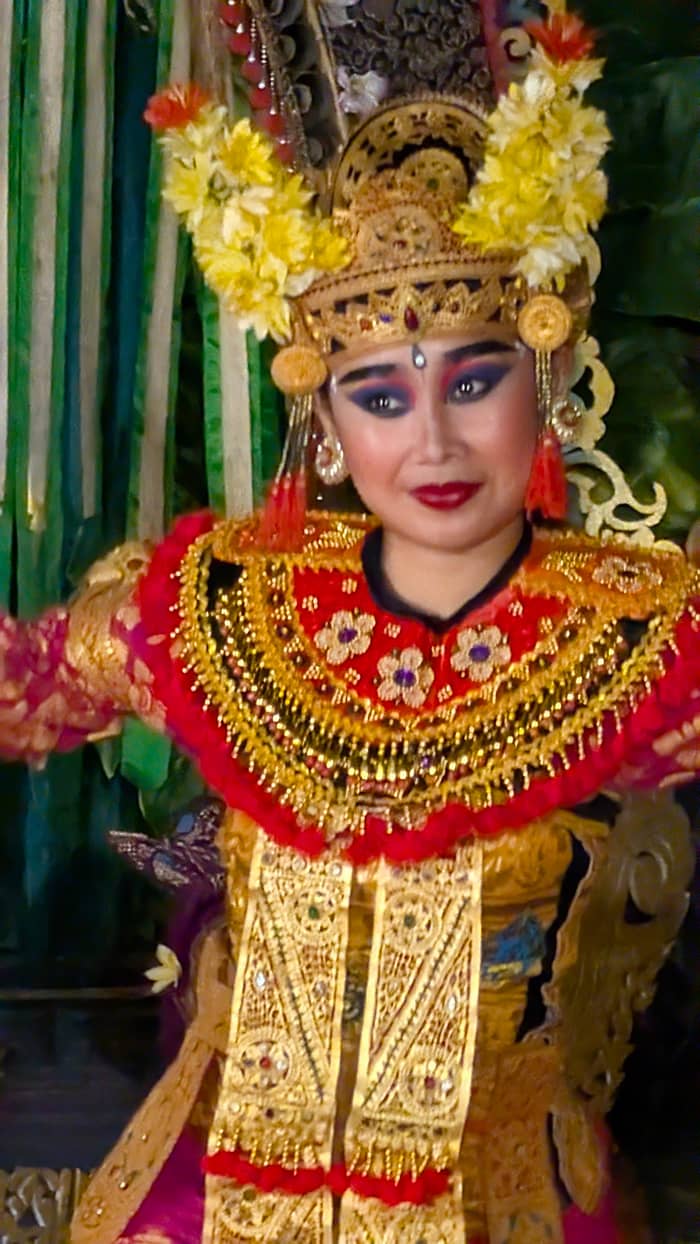
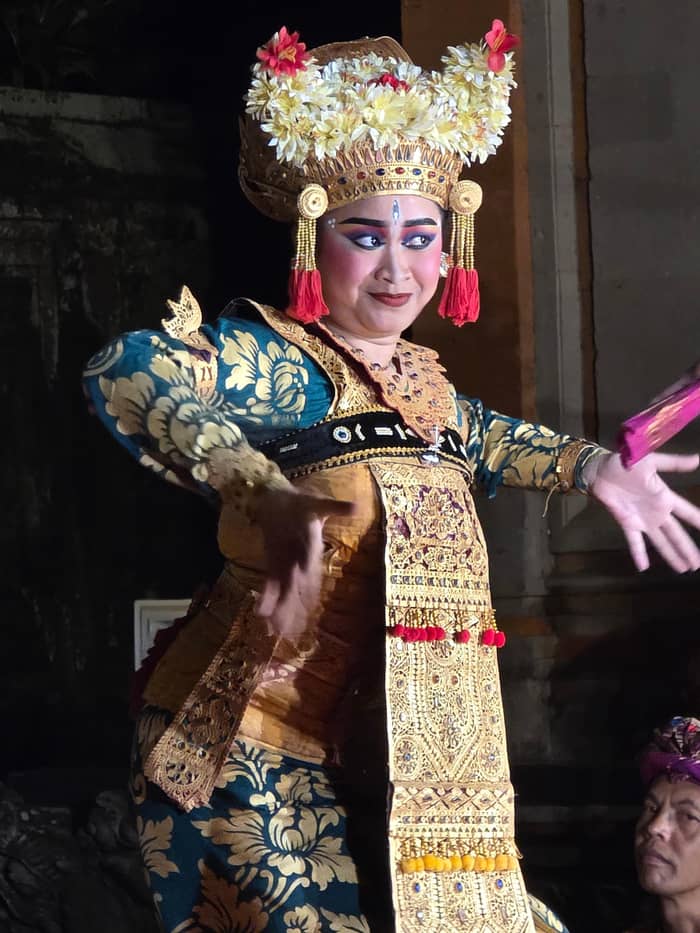
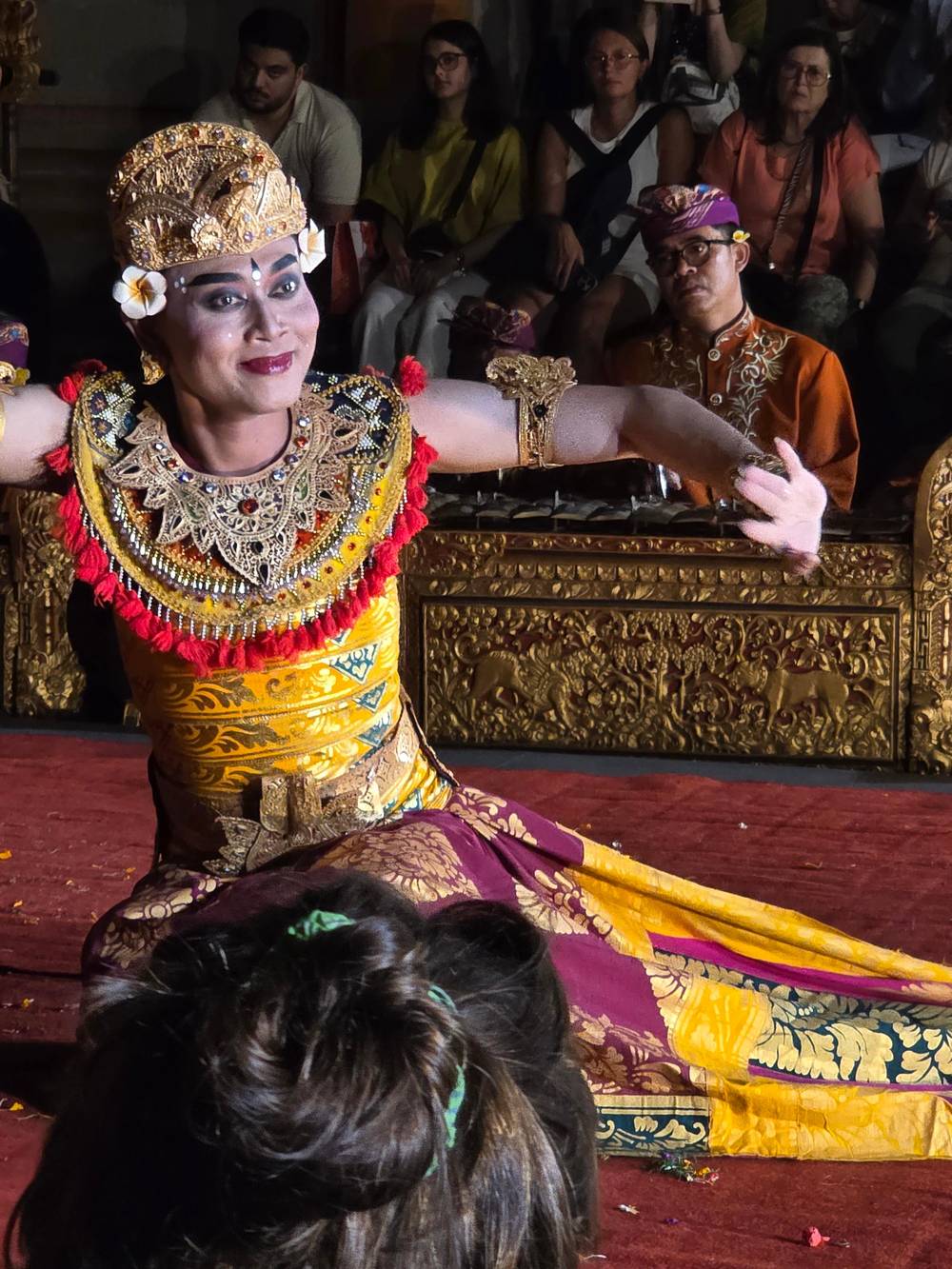
The Legong dance costume is a study in gold. The ministry describes vibrant silk sarongs and shimmering accessories under ornate golden headdresses.18 UNESCO adds brightly colored cloth painted with gold floral and faunal motifs, with gold-leafed and jeweled accessories.22 On a lit stage, the cloth wrapped tight around the torso throws back the light, and the tall crown turns every small movement of the head into a flash.
The music is gamelan, and the Legong draws on the compositions of gamelan gong kebyar, a traditional Balinese orchestra.19 Reviewers of our ticket single out the live music, the dancers and the costumes in the same breath. Listen for the way the drums cue a change in the dance, and watch how the dancers answer a beat a moment before it lands.
A Legong typically opens with a ceremonial passage honoring the gods, then narrates a mythological or historical story, and ends in a lively culmination.23 A single Legong can last between 30 minutes and an hour.4 The palace show runs about 90 minutes, and the listing does not itemize the running order, so treat the booklet as your program rather than expecting one particular dance.
Plan your palace evening
Before leaving the hotel
Go straight to Ubud Palace and present the voucher at the entrance; the ticket includes no pickup.
45 min ahead
The listing advises arriving at least 45 minutes ahead for preferred seating, and recent reviewers disagree on how early is early enough.
Beside the entrance
Reviewers mention a booklet handed out at the entrance that explains the dance, so read it before the lights go down.
19:30
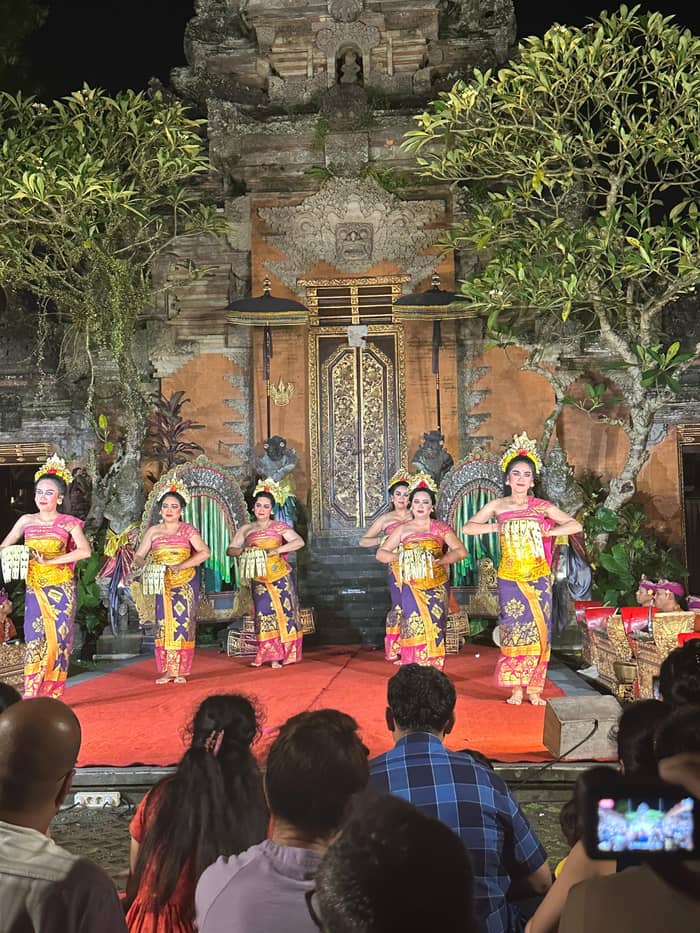
The show runs daily at 7:30 PM, with live music and costumed dancers in the palace courtyard.
Close to 90 min
The listing gives about 90 minutes for the show and a validity of 1.5 hours.
Afterward
The palace sits in the heart of Ubud, so the lanes outside are the next stop.12
The tourism ministry's page on Ubud Palace says traditional Balinese dance is often staged in the palace courtyard every night.24 Our ticket is entry to the Legong show there: daily at 7:30 PM, about 90 minutes, valid on the date you pick, from $6. Go straight to the palace and show your voucher; no transfer is included.
Seating is the one thing worth planning. The listing recommends reaching the palace 45 minutes or more before the show for preferred seating. Recent reviewers split on it: some who arrived 25 to 30 minutes ahead still found good seats, and one wished they had come sooner. A reviewer also warns about mosquitoes outside the seating area, so bring repellent.
Children and adults pay the same admission rate, the ticket is valid for all passport holders, and the listing says the venue is wheelchair and stroller accessible. The activity is non-refundable, so pick the date with care. Once the gamelan starts, keep your phone low and your voice lower; the people around you came for the same hush.
Video
betapicts on YouTube · The video loads only after you press play.
According to legend, the inspiration for the Legong Dance came from a dream of a Balinese prince. In his dream, he saw celestial maidens gracefully dancing in ornate costumes.
Balinese dance is not one thing. UNESCO's list entry covers sacred, semi-sacred and entertainment dances, and the ministry says sacred dances are performed exclusively for religious ceremonies and rituals in temples.9,25 The Legong at a palace evening belongs to the entertainment side, which is made for visitors; a ceremony in a temple is not.
UNESCO's committee encouraged Indonesia to keep addressing possible threats from promoting Balinese dance festivities for tourists.26 You can help in small ways: arrive early rather than push in late, stay seated while the dancers are on stage, and keep flash and phone light out of the performers' eyes.
If a dance whets your appetite, the palace is not the only door. Puri Agung Peliatan, a palace in Peliatan village in Ubud, is described as open to the public and often hosting performances such as Legong and gamelan.27 Our guides to Balinese dance types and to Kecak versus Legong help you choose the next evening.
FAQ
The tourism ministry gives that range for a single Legong; the ticketed palace show lasts about 90 minutes.4
The ministry derives it from "leg", graceful movement, and "gong", the gamelan accompaniment.7
The listing states that children and adults are charged the same admission rate.
The ticket is valid on the selected visit date only, and the activity is listed as non-refundable.
Sources
Keep reading
Unsure about seats, timing or the booklet? A person replies here.