Tick-off evening list
Gamelan in Ubud: the musical ensemble that accompanies Legong dance
Evening list · 9 items
Gamelan listening checklist
Mark each item as you finish it; your marks stay on this device.
0 / 9 ready
All set for the evening. Only the ticket is left: your seat in the courtyard.
Get my Legong seatGamelan is the musical ensemble that accompanies Legong dance at Ubud Palace. This guide covers what it is made of, how its interlocking parts work, why Bali's version runs fast and how to listen when the show begins.
Editorial team, legongdanceshow.com · Updated November 5, 2026 · About 6 min to read
Open with this
- The ensemble namedThe ensemble behind Legong is a gamelan, drawing on the compositions of gamelan gong kebyar.1
- Instrument familiesMostly metal gongs, metallophones and kettles, with drums, bamboo flutes and strings.2
- The mechanismSeveral instruments play interlocking parts that form a single rhythm.3
- HeritageUNESCO inscribed gamelan on its Representative List in 2021.4
- At the palaceThe listing for our ticket promises live gamelan, with the show daily at 7:30 PM.
What the word gamelan covers
Indonesia.Travel defines gamelan as a traditional Indonesian musical ensemble dominated by percussion, mainly metal gongs, metallophones and kettles, complemented by drums, bamboo flutes and string instruments.2 UNESCO's wording is close: the ensemble typically includes xylophones, gongs, gong-chimes, drums, cymbals, string instruments and bamboo flutes.5
So gamelan is both an ensemble and the set of instruments it uses. It is a team sound: the ministry says the music is performed collectively, emphasizing harmony and cooperation rather than individual virtuosity.6 No single player is the star, and the pleasure lies in how the parts fit together.
UNESCO adds that men, women and children of all ages play gamelan, in rituals, ceremonies, traditional theatre, festivals and concerts.7 At the palace you hear the theater side of that range: live music made for the dance.
Who plays for whom
Accompaniment across dances and settings
| Setting | What plays | What else the source says |
|---|---|---|
| Legong | Compositions of gamelan gong kebyar.1 | Percussion including gongs, metallophones and drums.16 |
| Baris warrior dance | Gamelan gong kebyar or gong gede.13 | The rhythm varies from slow to fast, following the dance movements.17 |
| Kecak | No gamelan, only a chanting chorus of men.14 | One soloist guides the chorus and also narrates.18 |
| Ubud Palace show | Live gamelan, promised in the listing. | Starts at 7:30 PM every day; about 90 minutes. |
| Pura Dalem Ubud courtyard | Gamelan music under the moonlight.19 | Legong is performed in the temple courtyard.19 |
Rows combine the tourism ministry's dance articles with the listing for our ticket; programs vary by night, so check the booklet.1
Balinese gamelan: fast, sharp and tied to ritual
The ministry describes Balinese gamelan as having fast tempos and dynamic rhythms, which reflect ritual intensity and expressive performances.11 Expect a sound that can switch from a whisper to a flurry within a few beats, nothing like the calm background music of a hotel lobby. Hearing it live is different from a recording: the metal vibrates in the air around you, and the contrast between loud and soft reaches the chest as much as the ears.
Its page on Bali lists the main ensembles as Gong Kebyar, Palegongan, Angklung, Gambang and Selonding.12 The name Palegongan echoes Legong, though the ministry's Legong article ties the dance's music to gamelan gong kebyar.1 Names matter to specialists; for a visitor the shared family sound is what counts.
The ministry's Baris article says the warrior dance is accompanied by gamelan gong kebyar or gong gede,13 so the same family of ensembles serves very different dances. Kecak is the exception: it has no gamelan and is accompanied only by the chanting of a chorus of men.14
How long the music runs
A single Legong against the whole evening
- Shortest Legong30 min
- Longest Legong60 min
- Head start45 min
- Whole show night90 min
The ministry says a Legong can last between 30 minutes and an hour, while the listing gives about 90 minutes for the show and advises arriving at least 45 minutes early.15
Instruments you may hear named
Indonesia.Travel names Balinese bamboo instruments, the rindik, jegog and suling (flute), and other instruments including the gangsa, gender, reong, terompong, gong, kendang and ceng-ceng.21 Few of those names will appear on a program, so the practical approach is to listen for families of sound. A good first target is the ringing, bell-like layer on top, the sound people mean when they say gamelan.
Metal does most of the talking, since the ministry calls the ensemble dominated by percussion made mainly of metal.2 Gongs and metallophones give the ringing, shimmering surface, drums shape the tempo, and a flute or a string instrument may add a sustained line. Which pieces appear on a given night belongs to the performers; the listing promises live gamelan music with the performance, not a particular instrument list.
Make a game of it. When a bright, rapid pattern appears, ask which instruments share it; when the sound drops to a slow, deep note, you are hearing the gongs that mark time. The booklet handed out at the entrance can help you match sounds with the story.
Tune your evening
What would you like out of the music?
The gamelan rewards a little attention, and each kind of listener has a simple route in.
If I want to follow the rhythm
Watch for interlocking parts
Several instruments may play interlocking parts that form a single rhythm.3
If I want to know what is playing
Read the entrance booklet
Reviewers mention a booklet at the entrance that explains the dance.
If I want more gamelan after the show
Look at Peliatan and Pura Dalem
Peliatan often stages Legong and gamelan, and Pura Dalem hosts Legong with gamelan.20,19
If I prefer chanting to metal
Choose a Kecak evening
Kecak has no gamelan; a chorus of men chants instead.14
If kids join you
The ticket keeps one price
Children and adults pay the same rate, and gamelan is played by people of all ages.7
How the parts interlock
UNESCO explains the principle: the melody is played simultaneously by a group of instruments, and multiple instruments may play interlocking parts to form a single rhythm.3 In plain terms, one player sounds the notes that another leaves silent, and together they produce a pattern too quick for a single pair of hands. Once you hear the trick you cannot unhear it: the bright, glittering surface is made of many hands, and the speed comes from sharing the load.
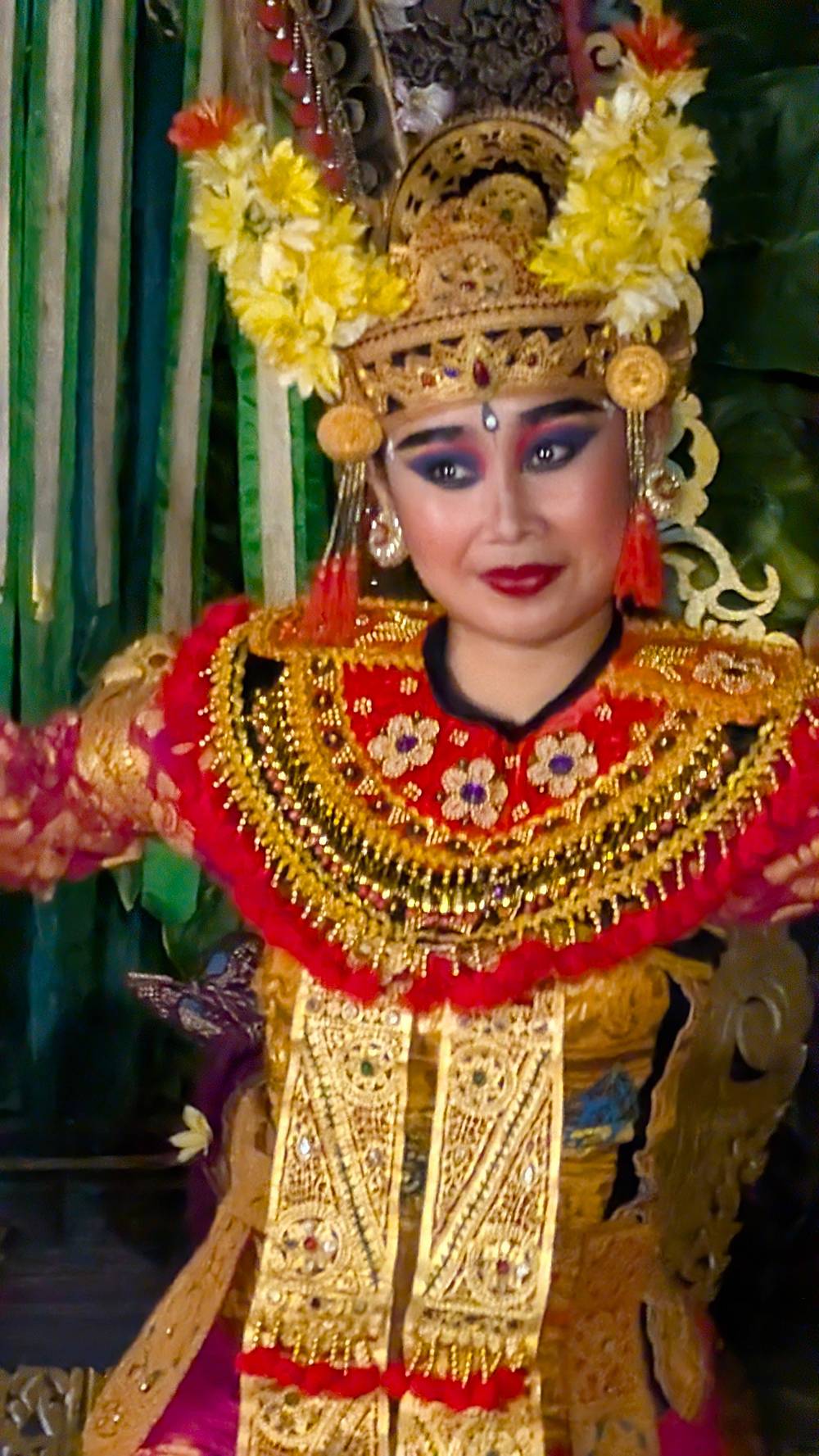
UNESCO also notes that gamelan music follows precise rules of tuning, layout, rhythmic and metric patterns and performance.22 That precision is why the ensemble sounds tight even at speed, and why dancers can lock their movements to it. Legong's seledet technique sends the dancers' eyes darting left and right, timed to the beat.23
UNESCO's text on Balinese dance says facial expressions and eye movements reveal happiness, sadness, anger, fear and love, all accompanied by gamelan music.24 Watch the dancers' eyes, then close your own for a moment; the music carries the same changes of mood.
Dates behind the sound
From temple reliefs to the palace courtyard
Borobudur era
Borobudur reliefs
UNESCO cites relief sculptures of the eighth-century Borobudur temple as archaeological evidence of gamelan.8
17th to 18th century
Legong takes shape
The ministry says Legong is believed to have originated in this age of royal courts.9
2015
Balinese dance listed
UNESCO inscribed UNESCO listing of three Balinese dance genres on the Representative List.10
2021
Gamelan listed
UNESCO inscribed gamelan on the same Representative List.4
7:30 PM tonight
The palace courtyard
The show behind our ticket runs daily at 7:30 PM with live gamelan.
Gamelan and Legong: a pairing with history
The ministry says Legong draws on the musical compositions of gamelan gong kebyar, a traditional Balinese orchestra.1 It places the dance's origin in the 17th or 18th century, in the age of the royal courts,9 and describes the accompaniment as percussion including gongs, metallophones and drums.16
The ministry derives the word Legong from leg, meaning graceful movement, and gong, meaning the gamelan accompaniment.25 The music is written into the name of the dance, which is a useful thing to remember when the first notes begin. Seen this way the evening is two arts at once, dance and orchestra, rather than a dance with background music.
UNESCO inscribed UNESCO listing of three Balinese dance genres in 2015, noting that the dances are accompanied by the music of the gamelan.10,24 Legong Kraton counts among the entertainment dances in Indonesia.Travel's list.26
Video
Bali's amazing, interlocking gamelan music
Augustine Esterhammer-Fic on YouTube · The video loads only after you press play.
the melody is played simultaneously by a group of instruments and multiple instruments may play interlocking parts to form a single rhythm
Hearing gamelan beyond the palace
Puri Agung Peliatan, a royal house in Peliatan village, is open to the public and often stages Legong and gamelan.20 The Pura Dalem temple in Ubud hosts Legong in its courtyard, with gamelan music under the moonlight.19
UNESCO inscribed gamelan on the Representative List of the Intangible Cultural Heritage of Humanity in 2021, and says archaeological evidence of the practice appears in the relief sculptures of the eighth-century Borobudur temple.4,8 The ministry traces its origins to the Hindu-Buddhist kingdoms, with temple reliefs and manuscripts suggesting sacred music in royal courts.27
A palace courtyard is therefore a natural home for it, since royal courts are where the ministry places early gamelan.27 The ticket we sell puts you in that setting for about 90 minutes. If the music grabs you, a later evening at Peliatan or Pura Dalem lets you compare how different venues stage it.20,19
Listening well on show night
Arrive at least 45 minutes before the 7:30 PM start; the listing says this secures preferred seating. Early arrival also gives you quiet minutes to read the entrance booklet before the first note.
Silence your phone, keep conversation for afterwards and hold applause until the dancers bow. Live gamelan is loud near the middle of the ensemble and delicate at the edges, so resist filming the whole piece: a short clip captures the rhythm, while a long one mostly captures the back of someone's head. Sit still during quiet passages, because the softest layers of the music are the first thing a rustling bag drowns out.
Mosquitoes outside the seating area were one reviewer's complaint, so repellent helps you sit still enough to listen. Afterwards, ask the staff or check the booklet for the name of the piece you liked, and search that name later to hear more of it.
FAQ
Brief questions, plain replies.
What is the musical ensemble accompanying Legong dance called?
The ministry says Legong draws on the compositions of gamelan gong kebyar, a traditional Balinese orchestra.1
What is a gamelan made of?
Indonesia.Travel names metal gongs, metallophones and kettles, with drums, bamboo flutes and string instruments.2
Is there live gamelan at the Ubud Palace show?
The highlights of the listing promise live gamelan music with the performance.
Why does Balinese gamelan sound so fast?
The ministry says Balinese gamelan features fast tempos and dynamic rhythms, reflecting ritual intensity.11
Is gamelan a UNESCO heritage?
UNESCO inscribed it on the Representative List of the Intangible Cultural Heritage of Humanity in 2021.4
Does Kecak use a gamelan?
Kecak has no gamelan; it is accompanied only by the chanting of a chorus of men.14
Who plays gamelan?
UNESCO says men, women and children of all ages play it.7
Sources
- Indonesia.Travel (Ministry of Tourism of Indonesia) · Legong Dance ↩
- Indonesia.Travel (Ministry of Tourism of Indonesia) · Gamelan: Indonesia's Living Musical Heritage ↩
- UNESCO Intangible Cultural Heritage · Gamelan ↩
- UNESCO Intangible Cultural Heritage · Gamelan ↩
- UNESCO Intangible Cultural Heritage · Gamelan ↩
- Indonesia.Travel (Ministry of Tourism of Indonesia) · Gamelan: Indonesia's Living Musical Heritage ↩
- UNESCO Intangible Cultural Heritage · Gamelan ↩
- UNESCO Intangible Cultural Heritage · Gamelan ↩
- Indonesia.Travel (Ministry of Tourism of Indonesia) · Legong Dance ↩
- UNESCO Intangible Cultural Heritage · UNESCO listing of three Balinese dance genres ↩
- Indonesia.Travel (Ministry of Tourism of Indonesia) · Gamelan: Indonesia's Living Musical Heritage ↩
- Indonesia.Travel (Ministry of Tourism of Indonesia) · Bali geography, history, culture and sights ↩
- Indonesia.Travel (Ministry of Tourism of Indonesia) · Tari Baris ↩
- Indonesia Travel (Ministry of Tourism, Republic of Indonesia) · The Dramatic Kecak Dance: Episode Taken from the Ramayana Epic Poem ↩
- Indonesia.Travel (Ministry of Tourism of Indonesia) · Legong Dance ↩
- Indonesia.Travel (Ministry of Tourism of Indonesia) · Legong Dance ↩
- Indonesia.Travel (Ministry of Tourism of Indonesia) · Tari Baris ↩
- Indonesia Travel (Ministry of Tourism, Republic of Indonesia) · The Dramatic Kecak Dance: Episode Taken from the Ramayana Epic Poem ↩
- Indonesia.Travel (Ministry of Tourism of Indonesia) · Legong Dance ↩
- Indonesia.Travel (Ministry of Tourism of Indonesia) · Puri Agung Peliatan: Istana Bersejarah di Ubud, Bali ↩
- Indonesia.Travel (Ministry of Tourism of Indonesia) · Bali geography, history, culture and sights ↩
- UNESCO Intangible Cultural Heritage · Gamelan ↩
- Indonesia.Travel (Ministry of Tourism of Indonesia) · Legong Dance ↩
- UNESCO Intangible Cultural Heritage · UNESCO listing of three Balinese dance genres ↩
- Indonesia Travel (Ministry of Tourism, Republic of Indonesia) · Legong Dance ↩
- Indonesia.Travel (Ministry of Tourism of Indonesia) · Three Genres of Balinese Dance UNESCO Heritage ↩
- Indonesia.Travel (Ministry of Tourism of Indonesia) · Gamelan: Indonesia's Living Musical Heritage ↩
Keep reading